
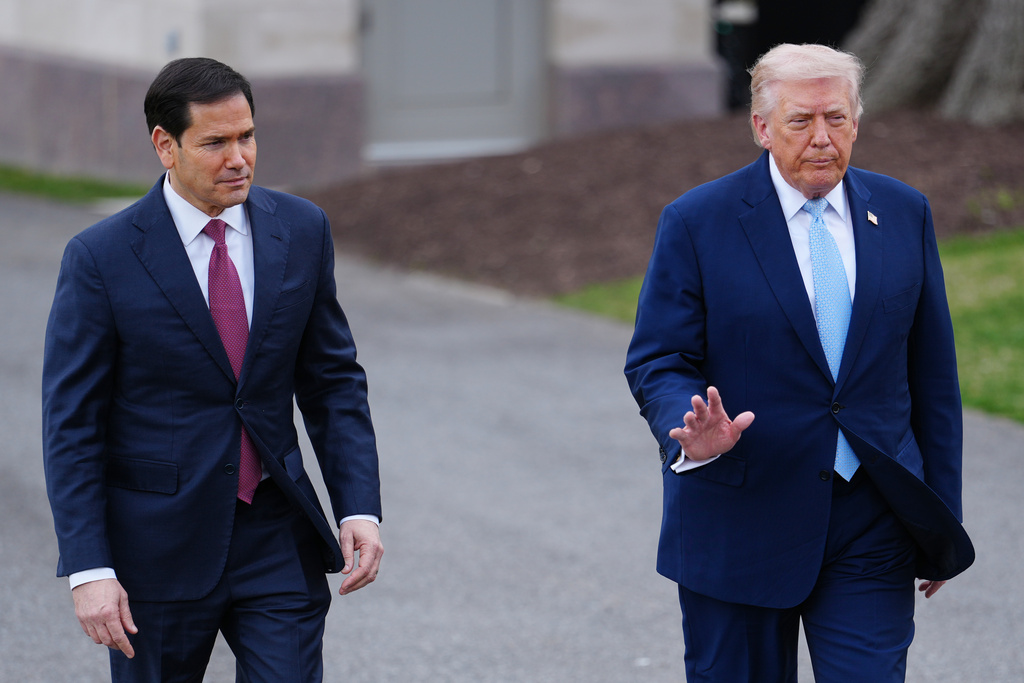
Secretary of State Marco Rubio rejected Iran’s conditions for reopening the Strait of Hormuz on Monday, saying the country’s proposal amounts to extortion rather than a genuine opening of the critical waterway.
“What they mean by opening the straits is, yes, the straits are open, as long as you coordinate with Iran, get our permission, or we’ll blow you up and you pay us,” Rubio said in an interview with Fox News. “That’s not opening the straits. Those are international waterways.”
The standoff over the Strait of Hormuz intensified Tuesday as Western powers pursued conflicting strategies. While the United States maintains a blockade on Iranian ports, Britain distanced itself from the policy even as it supported efforts to reopen the waterway, and France launched diplomatic overtures toward Tehran.
Rubio said the United States would not accept any Iranian terms that granted Tehran control over passage through the strait, which handles roughly 20 percent of global crude oil trade.
“They cannot normalize, nor can we tolerate them trying to normalize, a system in which the Iranians decide who gets to use them,” Rubio said.
Britain’s position on the blockade created an opening for potential negotiation. Stephen Doughty, Britain’s minister of state for Europe and North America, told UN reporters that while London does not support the U.S. blockade of Iranian ports, it shares Washington’s commitment to reopening the strait.
“Maritime traffic must flow safely and unimpeded through the strait,” Doughty said ahead of a UN Security Council meeting on navigation safety in the waterway. “That includes no tolls, no security risk and, of course, adherence to the international laws on freedom of navigation.”
Doughty characterized Iran’s position as a form of coercion. “Iran is holding the rest of the world to ransom,” he said, adding that diplomacy remained essential to resolving the crisis.
France signaled an independent diplomatic track. President Emmanuel Macron, speaking from Andorra after a two-day visit, said he would contact Iranian authorities to push for the strait’s reopening.
“We have established a coalition whose purpose is precisely to ensure security, to secure and stabilize, to demonstrate that the international community supports an opening,” Macron told reporters. “I hope that we will be able to convince the stakeholders in the coming days.”
France’s foreign minister, Jean-Noel Barrot, delivered a sharper message at the UN Security Council, saying Iran must make substantial concessions to end the crisis.
“There can be no lasting solution to this crisis unless the Iranian regime agrees to major concessions and a radical shift in its stance,” Barrot said.
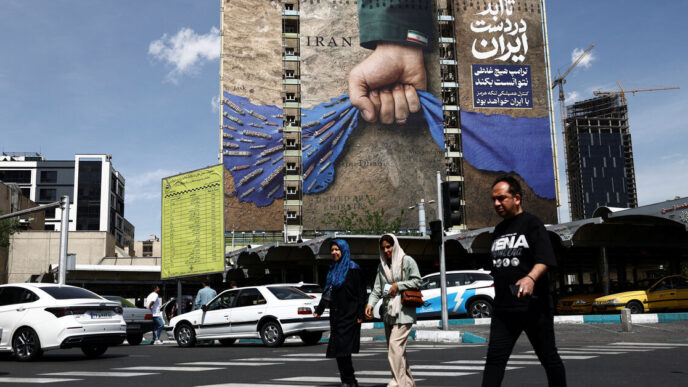
Iran’s Foreign Minister Abbas Araghchi signaled openness to talks with the Trump administration, saying Tehran was examining a U.S. request for negotiations. In remarks made during a visit to Russia, Araghchi said Trump had sought talks because American objectives had not been achieved.
“The United States has not achieved any of its objectives,” Araghchi told reporters in Saint Petersburg, where he met with President Vladimir Putin.
Araghchi framed the standoff as evidence of Iranian strength. “Due to the war with the United States and Israel, the world has now realized Iran’s true power,” he said, describing the Islamic Republic as “a stable, solid and powerful system.”
The Iranian foreign minister reaffirmed Russia’s backing and pledged continued strategic cooperation between Tehran and Moscow, positioning the partnership as central to Iran’s position in the crisis.
Doughty stressed that deescalation and a ceasefire were necessary conditions for any resolution, but emphasized that Iran could not be permitted to maintain control over the strait, continue attacks on Gulf neighbors and civilian infrastructure, or advance its nuclear program.
(YWN World Headquarters – NYC)