
Standard Chartered has provided a $2.33 billion syndicated financing facility to support key sections of Tanzania’s Standard Gauge Railway project, marking a major milestone in East Africa’s infrastructure development drive.
The financing was disclosed in a statement published on the bank’s website on Wednesday.
It will support the construction of Lots 3 and 4 of the railway line linking Makutupora to Isaka, as part of Tanzania’s broader plan to connect Dar es Salaam to Mwanza through a modern rail corridor aimed at boosting trade and logistics efficiency.
Standard Chartered said the financing package supports one of Tanzania’s most important infrastructure projects, designed to modernise rail transport and strengthen regional connectivity across East Africa.
The facility brings together export credit agency-backed funding and long-term financing from commercial banks and development finance institutions.
The bank also coordinated a separate $559 million Sinosure-covered facility for Lot 5. It acted as Sole Global Coordinator, Bookrunner, Mandated Lead Arranger, Facility Agent, and Lender to Tanzania’s Ministry of Finance, working with export credit agencies including Sweden’s EKN and SEK, Poland’s KUKE, and Italy’s SACE.
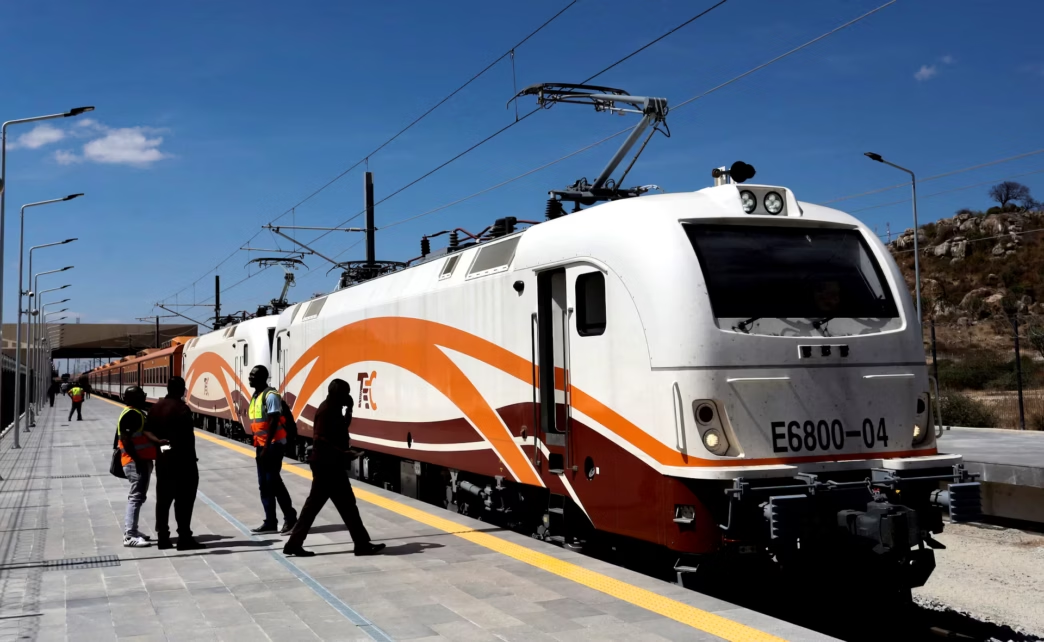
Tanzania’s Standard Gauge Railway is part of a long-term infrastructure plan aimed at replacing the country’s older metre-gauge rail system with a faster and higher-capacity network.
Standard Chartered previously arranged $1.46 billion in financing for Lots 1 and 2 in 2020, reinforcing its continued involvement in the project’s rollout.
The railway corridor is expected to become one of East Africa’s most important logistics routes once completed, linking the Indian Ocean port of Dar es Salaam to Lake Victoria in Mwanza.
It could serve as a key export route for landlocked neighbouring countries
The project is also seen as part of a wider push for infrastructure-led growth across East Africa, with governments prioritising rail networks to ease pressure on road transport and reduce logistics bottlenecks.
In February, Uganda announced plans to link its own standard gauge railway network to Tanzania’s rail system, creating a direct export corridor through the port of Dar es Salaam.
The broader plan could eventually extend to the Democratic Republic of Congo
The initiative reflects growing regional interest in integrated rail infrastructure as a tool for improving trade efficiency across East Africa.
Nigeria is also pursuing a similar cross-border rail project through the Kano Maradi railway, designed to connect northern Nigeria with Niger Republic.
The 283.75-kilometre project was approved in 2020 with a budget of $1.96 billion
The project is intended to improve freight and passenger movement while supporting regional integration. However, progress suggests that the initial 2026 completion target is unlikely to be achieved.