
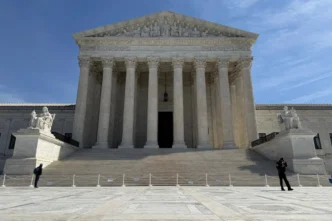
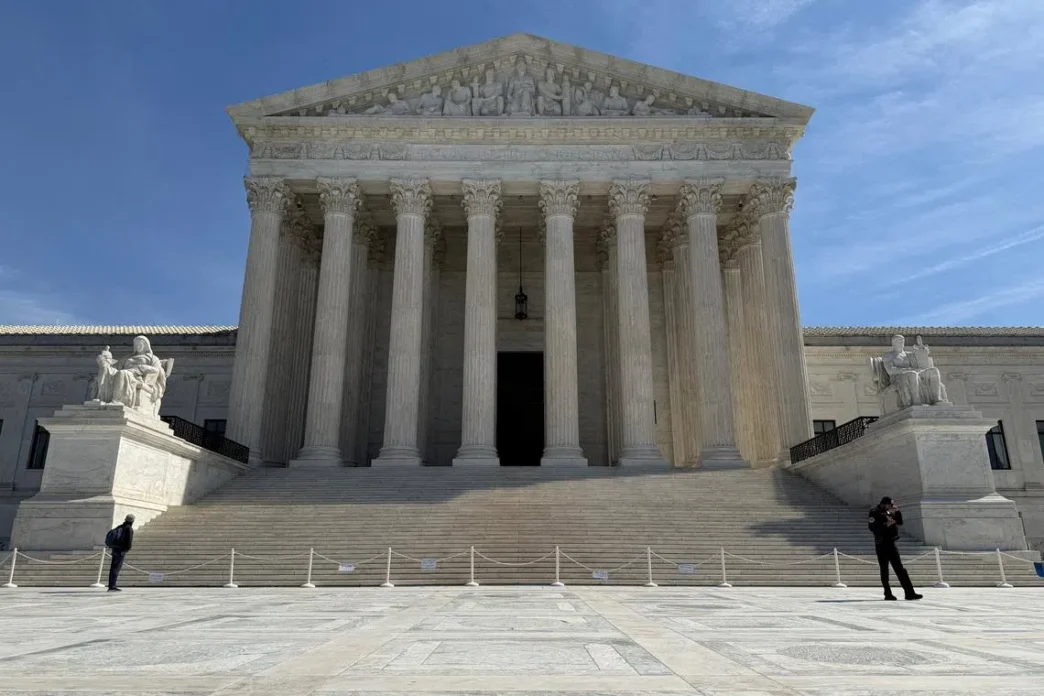
WASHINGTON, April 29 – The U.S. Supreme Court on Wednesday undermined a key provision of the landmark Voting Rights Act, handing a victory to Louisiana Republicans and President Donald Trump’s administration by blocking an electoral map that had given the state a second Black-majority congressional district.
The justices, in a 6-3 ruling, upheld a lower court’s ruling that blocked the map. The lower court found that the map was guided too much by racial considerations in violation of the constitutional promise of equal protection under the law.
The court has a 6-3 conservative majority. The ruling was authored by Justice Samuel Alito and joined by his five fellow conservative justices. The three liberal justices dissented.
The ruling was issued amid a battle unfolding in Republican-governed and Democratic-led states around the country involving the redrawing of electoral maps to change the composition of congressional districts for partisan advantage ahead of the November congressional elections.
President Donald Trump’s party is aiming in the elections to retain the now razor-thin Republican majorities in the U.S. House of Representatives and Senate.
The Louisiana case involved a central element of the Voting Rights Act. The law’s Section 2 was enacted by Congress to prohibit electoral maps that would result in diluting the clout of minority voters, even without direct proof of racist intent.
Legal analysts said before the ruling was issued that a decision undercutting Section 2 could benefit Republican candidates.
This provision gained greater significance as a bulwark against racial discrimination in voting after the Supreme Court, in a 2013 ruling authored by conservative Chief Justice John Roberts, gutted a different part of the same law.
Justice Elena Kagan, in a dissent joined by the two other liberal justices, said that the ruling will have major consequences.
“Under the court’s new view of Section 2, a state can, without legal consequence, systematically dilute minority citizens’ voting power. Of course, the majority does not announce today’s holding that way. Its opinion is understated, even antiseptic. The majority claims only to be ‘updating’ our Section 2 law, as though through a few technical tweaks,” Kagan said.
“But in fact, those ‘updates’ eviscerate the law, so that it will not remedy even the classic example of vote dilution given above,” she added.
The Trump administration backed the challenge made in the Louisiana case to the Voting Rights Act, advocating for raising the bar for proving a Section 2 violation.
Louisiana, where Black people make up roughly a third of the population, has six U.S. House of Representatives districts. Black voters tend to support Democratic candidates.
In a process called redistricting, the boundaries of legislative districts across the United States are reconfigured to reflect population changes as measured by the national census conducted every 10 years. Redistricting typically has been carried out by state legislatures once per decade.
After Louisiana’s Republican-controlled legislature adopted a map that included just one Black-majority district following the 2020 census, a group of Black Louisiana voters sued. A federal judge then ruled in favor of the plaintiffs, deciding that the map likely harmed Black voters in violation of Section 2.
The state legislature responded by drawing a new map that added a second Black-majority district. This map prompted a separate lawsuit by 12 Louisiana voters who described themselves in court papers as “non-African American.” They argued that the second Black-majority district unlawfully reduced the influence of non-Black voters like them. White people make up a majority of Louisiana’s population.
The redrawn map relied too heavily on race in violation of the equal protection principle, a three-judge panel found in a 2-1 ruling, prompting the appeal to the Supreme Court.
The Supreme Court has rolled back protections under the Voting Rights Act. Its 2013 ruling in a case involving Alabama’s Shelby County gutted a Voting Rights Act provision that had required states and locales with a history of racial discrimination to get federal approval to change voting laws.
The court, however, ruled 5-4 in 2023 that a Republican-drawn electoral map in Alabama violated Section 2, siding with Black voters who had challenged the map and had sought an additional Black-majority congressional district. Roberts and fellow conservative Justice Brett Kavanaugh joined the court’s three liberals to form a majority in that decision.
The Supreme Court heard arguments in the Louisiana case in October 2025. It previously had heard arguments in the case in March 2025, but sidestepped a decision and ordered another round of arguments.
Louisiana initially had appealed the three-judge panel’s ruling and argued in March on the same side as the Black voters. But the Republican-led state subsequently changed its stance and has urged the justices to effectively eliminate race-conscious redistricting as a remedy for a Section 2 violation. REUTERS