
Peacebuilding training targets Ijaw, Itsekiri, Urhobo tensions in Warri
Centre for Peace and Environmental Justice leads capacity-building initiative
Stakeholders warn politicians against exploiting ethnic divisions before 2027 elections
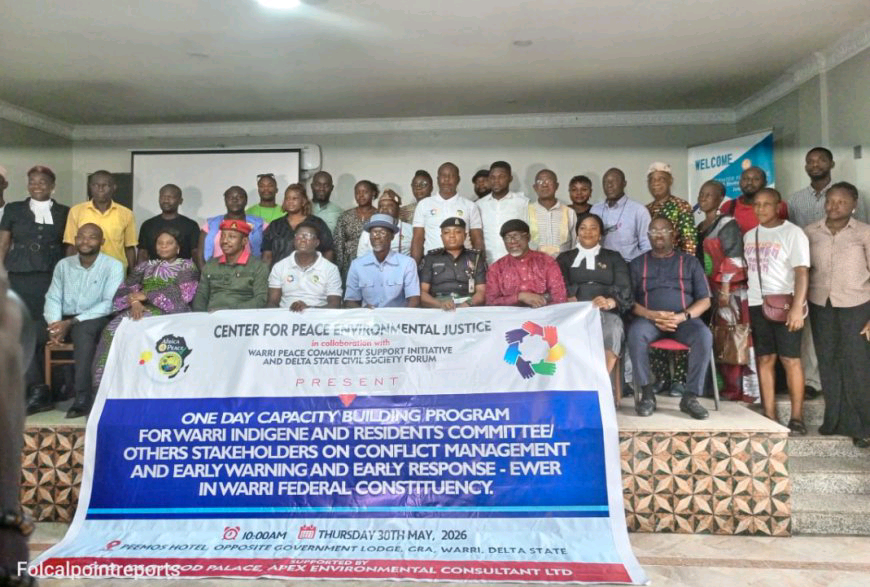
A fresh push for peace in Delta State has gathered momentum as the Centre for Peace and Environmental Justice (CEPEJ) organised a capacity-building programme aimed at preventing ethnic conflicts in Warri.
The one-day training, held in Warri South Local Government Area, brought together community leaders, civil society groups, and security agencies to strengthen early conflict detection and response among members of the Warri Indigene and Residents Peacebuilding Committee.
ATTENTION: Click “HERE” to join our WhatsApp group and receive News updates directly on your WhatsApp!
The initiative comes amid lingering tensions among the Ijaw, Itsekiri and Urhobo ethnic groups, particularly following recent ward delineation exercises by the Independent National Electoral Commission (INEC).
READ ALSO: Warri Federal Constituency: Oromoni Drags INEC, Parties to Court, Seeks Halt of 2027 Primaries Over Delineation Dispute
Speaking at the event, CEPEJ National Coordinator, Sheriff Mulade, stressed that peaceful coexistence in Warri is non-negotiable, warning against any attempt to dominate or displace others.
“Peaceful coexistence among the Ijaw, Itsekiri, and Urhobo ethnic groups remains inevitable… no group can displace another from Warri,” he said.
Mulade urged stakeholders to embrace what he described as the “3Cs” — Communication, Cooperation and Coexistence — as the foundation for lasting peace in the region.
He explained that the Peacebuilding Committee, set up in March 2026, was a response to growing tensions linked to electoral boundary adjustments across Warri North, Warri South and Warri South-West.
“This programme is targeted at strengthening the capacity of the committee to de-escalate tensions and foster unity among the communities,” he added.
The CEPEJ coordinator also raised concerns over the potential misuse of ethnic and religious sentiments by politicians ahead of the 2027 general elections, urging leaders to prioritise unity over division.
“Peace cannot be achieved by government or security agencies alone; it must involve everyone,” Mulade said.
Participants were trained on Early Warning and Early Response (EWER) mechanisms, with practical sessions on identifying conflict signals and engaging relevant authorities before crises escalate.
Also speaking, Martha Onose, Executive Director of the Community Empowerment and Development Initiative, highlighted the economic toll of conflicts, noting that disputes often destroy livelihoods and deepen poverty.
Another resource person, Fater Kyegh, an Early Warning analyst, emphasised that conflict prevention tools are not limited to large crises but are equally effective in addressing everyday tensions.
Organisers commended security agencies for their continued efforts in maintaining stability in Warri, while calling for sustained collaboration among stakeholders to secure long-term peace in the region.