
The kiwi, New Zealand’s sacred national bird, vanished from the hills around Wellington more than a century ago.
But now the capital’s residents are waging an improbable citizen campaign to return the endangered flightless birds to the city.
“They are a part of who we are and our sense of belonging here,” said Paul Ward, founder of the Capital Kiwi Project, a charitable trust.
“But they’ve been gone from these hills for well over a century and we decided as Wellingtonians that wasn’t right.”
On a hill wreathed in mist above the dark sea that runs between New Zealand’s North and South Islands, Mr Ward and others crossed rugged farmland late on Tuesday night, carrying seven crates in silence by dim red torchlight.
Inside each one nestled a kiwi, including the 250th bird relocated to Wellington since the Capital Kiwi Project began.
The kiwi gives New Zealanders the name by which they are often known.
It is a shy and odd-looking bird with underdeveloped wings and a whiskery face.
Spiritually significant for many New Zealanders, the kiwi’s image appears everywhere, including on the tail of the country’s air force planes — curious for a bird with no tail which cannot fly.
It is thought that there were 12 million of the birds roaming the landscape before humans arrived in New Zealand.
Today only about 70,000 kiwi are left across the country, with the population dropping 2% each year.
In the hills where Wellington’s kiwi now live and breed, the only late-night sound on Tuesday was the whoosh of wind turbines.
Mr Ward and his friends set their crates down in pairs, slid them open and gently tilted the boxes.
Some in the small group of hushed onlookers were tearful and one man chanted a karakia, a Maori prayer.
From each crate, a long, curved beak eventually protruded as kiwi took their first tentative steps into the shadowed landscape, then sped to a run and disappeared into the darkness.
One place kiwi had never set foot until this week was inside New Zealand’s Parliament.
Hours before Wellington’s seven newest residents were transported to their hillside home, they were carried into Parliament’s grand banquet hall by handlers for a celebration of the 250th kiwi’s arrival in the city.
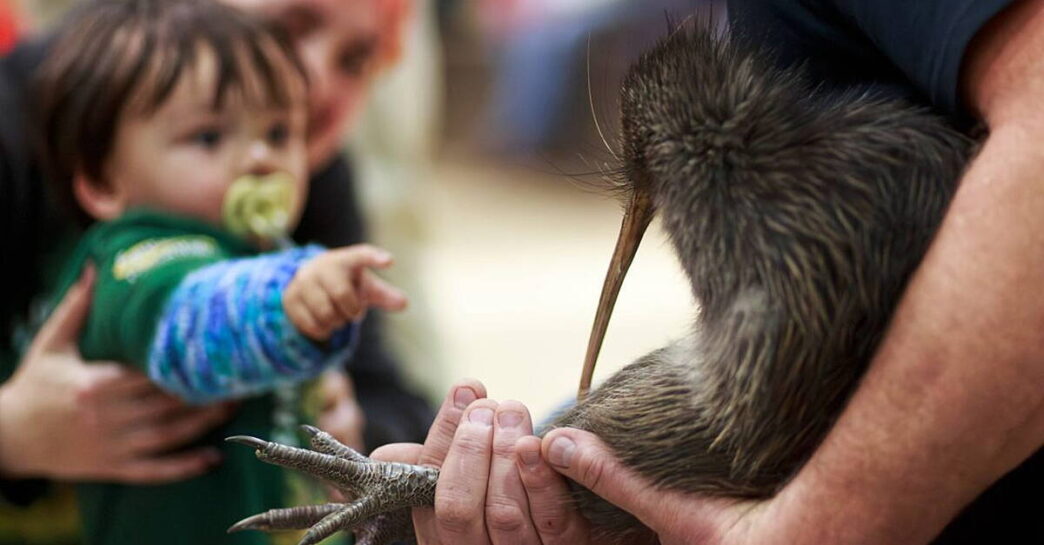
Legislators and schoolchildren alike expressed whispered delight at seeing the timid, nocturnal birds up close, many for the first time, as conservation workers cradled the large birds like human babies, with their gnarled feet outstretched.
“This animal has given us as a people so much in terms of our sense of identity,” Mr Ward told The Associated Press.
“We want to challenge our civic leaders, our politicians and say this is a relationship we need to honour.”
New Zealand is home to some of the world’s strangest and rarest bird species.
Some have only survived because of against-all-odds conservation programmes, at times with uncertain funding.
Initiatives decades ago saw all surviving birds of some species moved onto offshore, predator-free islands or into sanctuaries where they could be carefully monitored and protected, but where few New Zealanders would ever see one.
Although unmanaged kiwi populations are shrinking, their numbers have thrived in carefully managed wild bird sanctuaries — so much, in fact, that some of these protected areas have run out of room for them.
That has prompted their relocation to places like Wellington, where groups such as Mr Ward’s rally residents to embrace their new neighbours.
Kiwi have been spotted by late night mountain bikers and on backyard security camera footage in the capital, he said.
“They’re living and calling and being encountered on the hills surrounding our city,” Mr Ward said.
We have this incredible movement throughout the country where everyday people are taking it on under their own steam to do what they can to protect a threatened species
Over the past decade, efforts between landowners, the local Maori tribe and the Capital Kiwi Project have produced a sprawling, 24,000-hectare tract of land where kiwi can roam.
It is dotted with more than 5,000 traps for stoats, the main predator of kiwi chicks.
So far, the Wellington population has a 90% chick survival rate.
The kiwi initiative is part of New Zealand’s quest to rid the island nation of introduced predators, including feral cats, possums, rats and stoats, by the year 2050.
Since a previous government established the target in 2016 its chances of success have been debated, but community groups have taken up the work in earnest.
Parts of Wellington are now entirely free of mammalian predators apart from household pets, and native birds flourish.
Volunteers monitor suburbs with military precision for the appearance of a single rat.
“When I think of endangered species globally, for the most part you can’t do much other than campaign or donate money,” said Michelle Impey, chief executive of Save the Kiwi.
“But we have this incredible movement throughout the country where everyday people are taking it on under their own steam to do what they can to protect a threatened species.”