

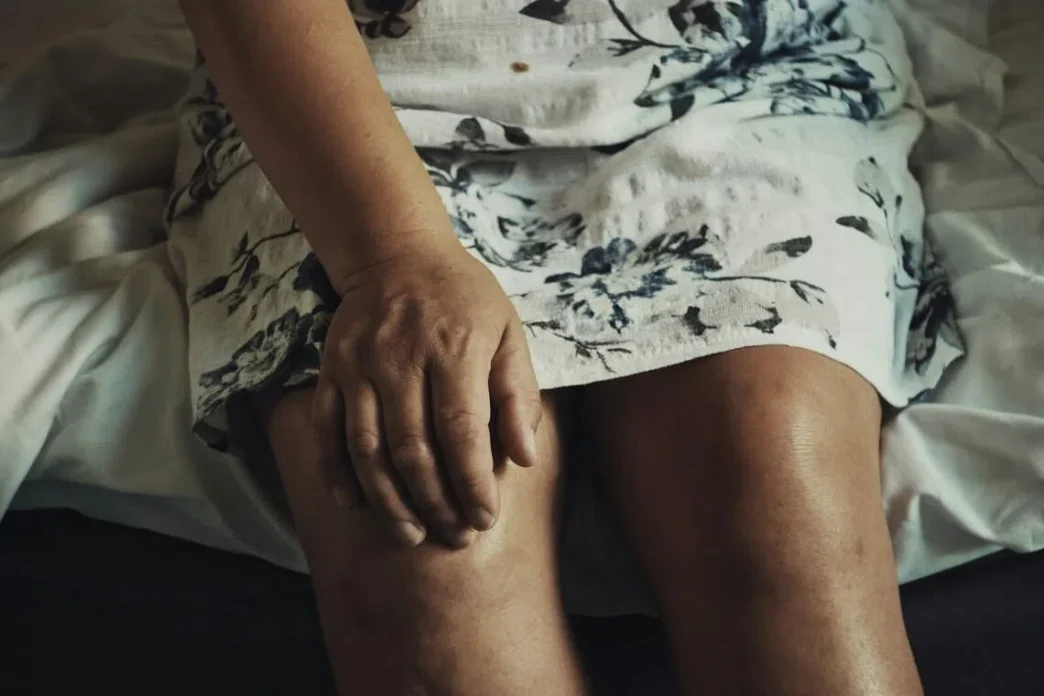
PARIS – No matter how much she exercised or dieted, Ms Aurelie Hamon’s legs have stubbornly amassed fat since adolescence, regularly causing her pain.
“Walking for more than 20 minutes was impossible without feeling extremely heavy and a tightening sensation,” the 47-year-old French sales representative told AFP.
Doctors kept telling her to get more exercise and eat less.
“But I had tried every diet imaginable – even my personal trainer could not understand why I wasn’t losing weight,” Ms Hamon said.
Then one day on social media, she stumbled across women describing something that resonated with her: a chronic condition called lipoedema.
This common but little-known condition involves an abnormal build-up of fat – usually in the legs but sometimes in arms – that is not linked to being overweight.
It can cause pain that makes an active daily life difficult, a disproportionate body shape, swelling, and skin that bruises easily.
Research has suggested lipoedema could affect as many as one in 10 women worldwide, however many may not realise it because the condition is often misdiagnosed.
And because it almost exclusively affects women, lipoedema has been compared to endometriosis and other female health problems long overlooked by a historically male-focused medical establishment.
Lipoedema has no known cause, but hormones are believed to play an important role because it can be triggered or made worse during puberty, pregnancy or menopause.
Genetic and inflammatory factors are also thought to play a role.
Lipoedema was first described in 1940, but only recognised as a disease in France in 2018.
For Ms Hamon, it took a year to have her diagnosis confirmed by a vascular specialist.
“On average, patients are diagnosed after 20 years of medical uncertainty,” said Ms Pascale Etchebarne, the head of a French association dedicated to the condition.
Patients can suffer from eating disorders or depression because “they feel intense guilt – they’re told to eat better, to make an effort,” she told AFP.
“Except they’re already doing that, with no result.”
In a paper published in the journal Nature Communications earlier in 2026, an international group of researchers lamented that the medical community still had little understanding of the condition.
“Lipoedema remains underdiagnosed,” they wrote.
The condition is often confused with obesity or tissue swelling called lymphedema, “leading to misdiagnosis and inadequate treatment,” the paper added.
French angiologist Michele Cazaubon said that conservative treatment includes “an anti-inflammatory diet, regular physical activity, wearing compression clothing, and lymph drainage”.
Ms Denise, a 34-year-old diagnosed with stage 1 lipoedema, followed this protocol.
“I’ve cut out alcohol and sugar, I eat an anti-inflammatory diet and drink 1.5 litres of water a day,” she said.
“I walk 8,000 to 10,000 steps a day and do three hours of strength training a week. Since starting, the swelling in my legs has gone down and I no longer have any bruising.”
For serious cases, therapeutic liposuction can be an option.
However several operations are often needed – and the expensive surgery is not covered by most national healthcare services.
After getting liposuction on her arms in Germany, Hamon launched a crowdfunding campaign to raise €29,000 (S$43,310) for surgery on her thighs and calves.
Ms Margo Chinea, a 25-year-old in France, had to take out a loan for her operation. “In total, it cost me €13,000,” she said.
But the surgery, which is different to cosmetic liposuction, can improve people’s quality of life.
“I no longer have any pain in my arms and I’ve gained mobility,” Ms Hamon said.
The Nature Communications paper said that “lipoedema reduction surgery should be considered when there is potential for a positive impact”.
In 2025, Ms Etchebarne’s association submitted an application to France’s health authorities for lipoedema treatment to be covered.
However the application was rejected due to a lack of “sufficient data”.
The French National Authority for Health told AFP it was waiting for “the results of ongoing scientific studies”.
Ms Etchebarne remains hopeful.
“It’s like endometriosis, for which this took 20 years. For us, it might take 10,” she said.
She plans to submit a new application in June 2028 – once more scientific research has been conducted. AFP