
MOSCOW, April 29 – A series of reversals suffered by Mali’s Moscow-backed military government has dented Russia’s image as a self-styled security guarantor in Africa and threatens its strategic and economic interests on the continent.
The military junta, which turned to Russia for support after expelling French and U.N. troops following coups in 2020 and 2021, was rocked at the weekend by an offensive by West Africa’s al Qaeda affiliate and a Tuareg-dominated separatist group.
Mali’s Russia-trained defence minister, Sadio Camara, was killed in a suicide bombing, Russia’s Africa Corps was forced to withdraw from Kidal – an important town that Russian mercenaries helped take in 2023 – and Moscow used helicopter gunships and strategic bombers to hold insurgents back.
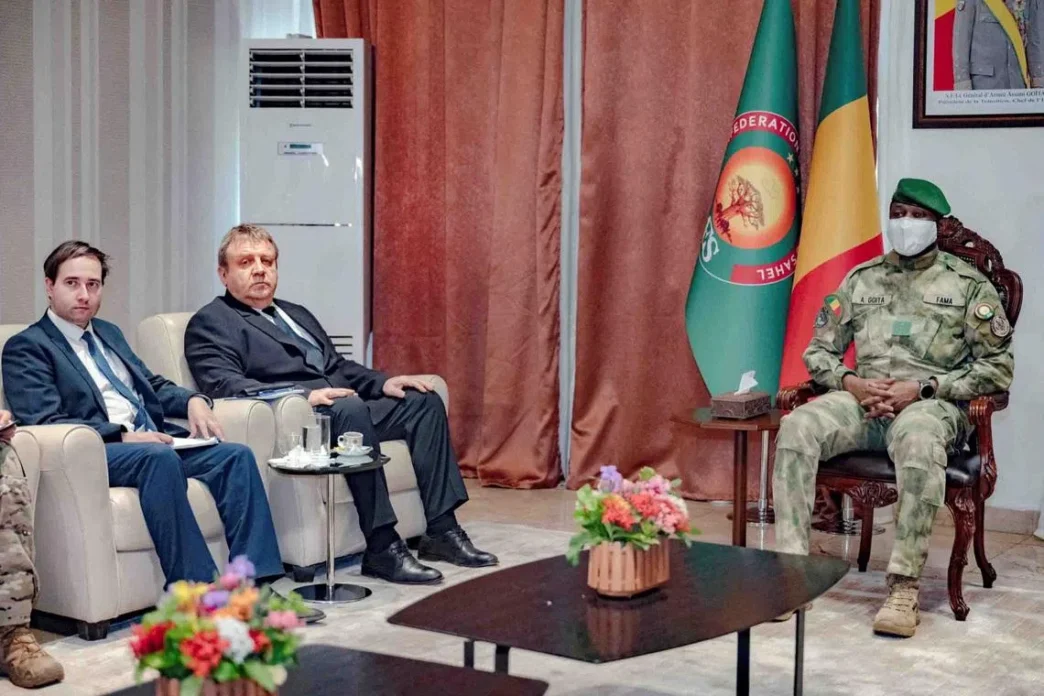
Assimi Goita, the junta leader who was welcomed in the Kremlin last summer by President Vladimir Putin, survived. But he now faces the prospect of armed groups trying to seize swaths of Mali’s vast desert north amid Russian warnings that the insurgents are regrouping.
The events could be a serious threat to Russian interests, political analysts say, and Moscow’s response is being closely watched abroad at a time when its forces are tied down fighting in Ukraine and its geopolitical influence is under pressure in other parts of the world.
“Mali is one of the centres of power for Russia in West Africa,” Irina Filatova, an Honorary Research Associate at the University of Cape Town, told Reuters.
She said Russia had strategic and economic interests in Mali, part of a chain of African countries including Burkina Faso, Niger and Central African Republic which Moscow had worked hard to cultivate in pursuit of geopolitical clout and access to mineral wealth in exchange for security protection.
“If the Russians cannot return Kidal very quickly it will be a big hit to their credentials as a source of strength and to the perception of their ability to protect the security of Mali and other countries,” said Filatova.
Héni Nsaibia, senior West Africa analyst at U.S. crisis-monitoring group ACLED, said he believed the junta’s future was now in jeopardy. That, he said, meant Russia’s military presence in Mali was also on the line.
“I think the successive campaigns, including (al Qaeda affiliate) JNIM’s earlier coordinated attacks, a fuel embargo, and the latest events illustrate the failure of Russian intervention, which by extension also threatens its strategic and economic interests in Mali and the Sahel more broadly,” said Nsaibia.
GOLD AND LITHIUM
Putin met Mali’s Goita in the Kremlin last June, calling him “Respected Mr President” and hosted him at a Russia-Africa summit in St Petersburg in 2023.
Russia signed a deal with Mali last year intended to pave the way for Moscow to one day build a nuclear power plant there, something the two sides have long discussed.
Russia has also been in talks to build a joint solar plant and has backed a lithium project. Mali last year began the construction of a Russian-backed gold refinery.
Historian Filatova said Moscow had tried to tap into resentment about Western colonialism to cast itself as a friendly power offering pragmatic cooperation rather than dependence.
“Russia will always be alongside Mali,” the state TASS news agency quoted Russia’s ambassador to Mali, Igor Gromyko, as saying on Wednesday, a day after a meeting with Goita at which Goita’s office said they had discussed “the current situation and the strong partnership between Bamako and Moscow.”
Flore Berger, senior Sahel analyst at the Global Initiative Against Transnational Organized Crime (GI-TOC), said Russia had suffered a short-term setback in Mali, but that it was too early to say whether its Africa Corps would need to pull out altogether or be reconfigured.
The Africa Corps, which is made up of many former fighters from the Wagner mercenary group that received Russian state funding, is estimated to number around 2,000 troops in Mali and is controlled by the Russian Defence Ministry, which has said its fighters are committed to keep carrying out their tasks.
“What happens to the junta will directly shape what happens to the Africa Corps and the Russian presence more broadly in Mali,” said Berger. “At the moment we do not know if the junta is going to recover or not. What we know is that it’s extremely weakened.” REUTERS